Engineering
Construction Procurement Strategies: A Comprehensive Guide for Quantity Surveyors

1. Introduction
In the construction industry, "Procurement" refers to the overall system used to organize the design and construction of a project. It defines the relationship between the Client (Employer), the Consultants (Engineers/Architects), and the Contractor.
Choosing the right procurement strategy is arguably the most important decision a Client makes. It determines who bears the risk for cost overruns, who is responsible for design errors, and how fast the project can be completed.
Broadly, there are three main procurement paths used in Sri Lanka and globally:
- Traditional Method (Design-Bid-Build)
- Design and Build (D&B)
- Management Methods (Construction Management)
2. Traditional Procurement (Design-Bid-Build)
This is the most established method, widely used in Sri Lanka for government infrastructure and public works. It is characterized by the complete separation of Design and Construction.
2.1 The Process
The workflow is linear and sequential:
- Design Phase: The Client appoints a team of consultants (Architects, Structural Engineers) to produce a fully detailed design and a Bill of Quantities (BOQ).
- Tender Phase: The project is advertised. Contractors price the BOQ. This ensures all contractors are pricing the exact same scope of work.
- Construction Phase: The successful contractor builds exactly what is on the drawings under the supervision of the Consultant.
2.2 Contractual Characteristics
Lump Sum or Remeasurement: The contract is usually based on a fixed price (Lump Sum) or approximate quantities that are measured upon completion (Remeasurement).
The "Engineer" Role: An independent Engineer administers the contract. They act as a neutral bridge between the Client and Contractor.
2.3 Critical Analysis
Pros: It offers the highest level of Cost Certainty and Quality Control. The Client retains full control over the design.
Cons: It is slow. Construction cannot begin until the design is 100% complete. Furthermore, the "us vs. them" separation often leads to adversarial relationships and disputes.
3. Design and Build (D&B)
In the modern private sector (apartments, hotels, offices), Design and Build has become the dominant method due to its speed and simplicity for the Client.
3.1 The Process
The Client does not commission a full design. Instead, they produce a document called the Employer’s Requirements (ER), which outlines the function and performance expected (e.g., "A 5-star hotel with 200 rooms and a pool"). The Contractor responds with Contractor’s Proposals (CP), detailing how they will achieve this.
3.2 The Concept of "Novation"
A key concept for students is Novation. Often, a Client hires an architect for the initial concept. Once the D&B Contractor is hired, that architect is "novated" (transferred) to work for the Contractor. The architect no longer works for the Client; they work for the builder.
3.3 Critical Analysis
Pros: Single Point of Responsibility. If the roof leaks, the Client calls the Contractor. They cannot blame the architect. It also allows for Fast-Tracking (starting foundations before the roof design is finished).
Cons: The Client loses control over detailed design. The Contractor may choose cheaper materials to save money, provided they meet the minimum requirements.
4. Management Procurement Systems
This category is misunderstood by many students. It is generally used for large, complex projects where the Client needs flexibility and speed but wants to retain design control. There are two main types:
4.1 Management Contracting
The Client hires a Management Contractor (MC). The MC does not do any physical work. Their job is to manage site logistics and hire Works Contractors (Sub-contractors) to do the piling, steelwork, cladding, etc.
- Contractual Link: The Client has a contract with the MC, and the MC has contracts with the Sub-contractors.
- Risk: The MC is usually paid a fee and is not liable for the default of the sub-contractors.
4.2 Construction Management (CM)
This is similar to the above, but with a crucial legal difference.
- Contractual Link: The Client hires a "Construction Manager" to act as a consultant. The Client then signs direct trade contracts with every individual sub-contractor (Piling contractor, Electrical contractor, etc.).
- Risk: The Client takes on massive risk because they are legally responsible for coordinating all these different trade contractors.
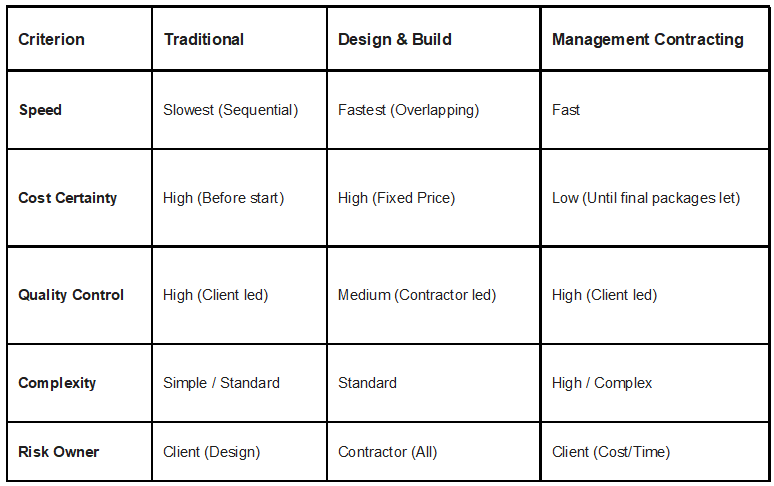
5. Selection Strategy: When to use what?
Quantity Surveyors use the "Project Constraints Triangle" to advise clients.
6. Conclusion
For a Quantity Surveyor, there is no "best" procurement path. The decision depends on the Client's priorities.
- Use Traditional if the Client is risk-averse, wants high quality, and has plenty of time (e.g., a Museum).
- Use Design & Build if the Client is a developer who needs to sell apartments quickly (e.g., a Residential Tower).
- Use Management Contracting if the project is huge, undefined, and needs to start immediately (e.g., an Emergency Hospital or Airport).
Understanding these distinctions is what separates a technician from a professional Quantity Surveyor.
7. Bibliography
Masterman, J.W.E. (2022). An Introduction to Building Procurement Systems. 3rd edn. London: Routledge.
Morledge, R. and Smith, A. (2021). Building Procurement. 3rd edn. Chichester: Wiley-Blackwell.
Ramus, J., Birchall, S. and Griffiths, P. (2020). Contract Practice for Surveyors. 4th edn. Oxford: Butterworth-Heinemann.
RICS (2024). Appropriate Contract Selection. [online] Royal Institution of Chartered Surveyors. Available at: https://www.rics.org/global-standards [Accessed 11 Jan. 2026].
Test Your Knowledge!
Click the button below to generate an AI-powered quiz based on this article.
Did you enjoy this article?
Show your appreciation by giving it a like!
Conversation (0)
Cite This Article
Generating...
.jpg)