Technology
Neural Networks, CNNs, RNNs, and Transformers - The Engines Behind Today’s Intelligent Systems
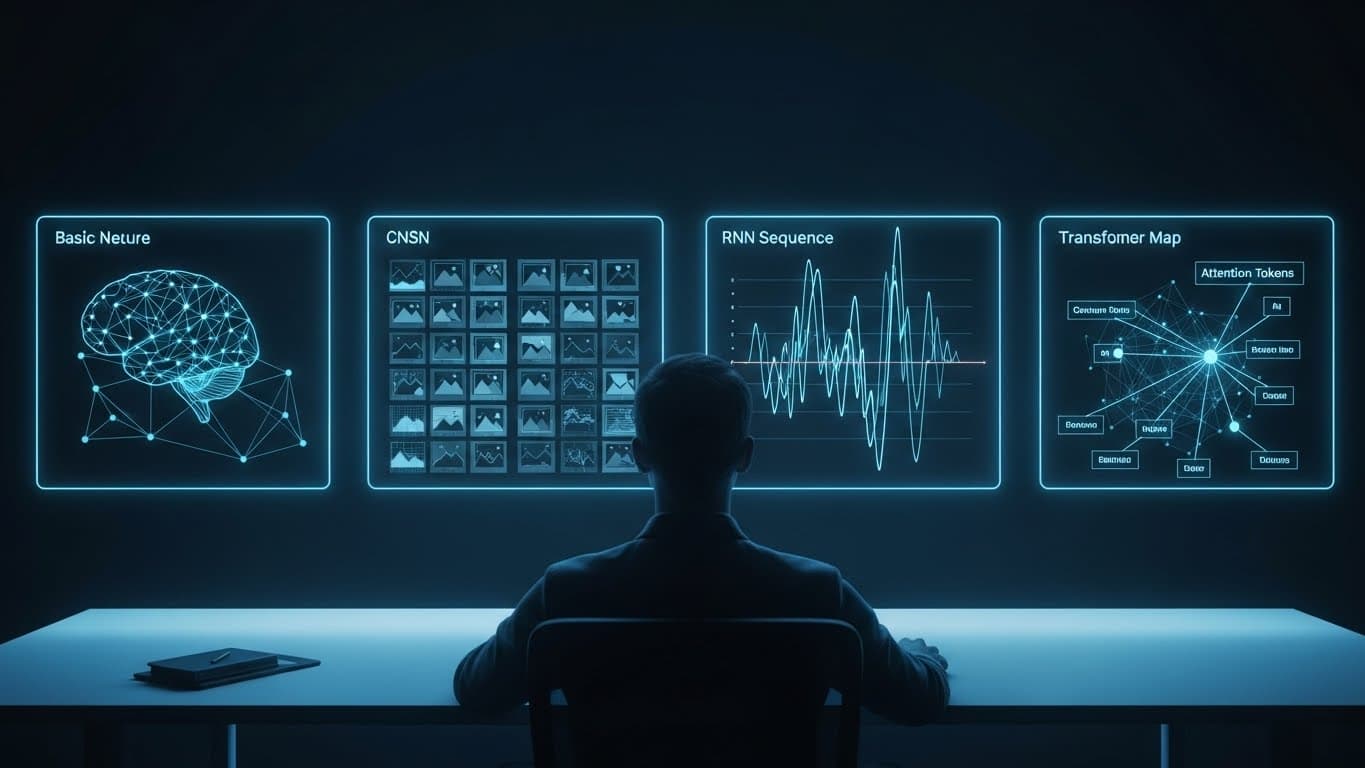
Artificial Intelligence is no longer a distant concept it quietly shapes daily life, from unlocking phones with face recognition to auto generated subtitles, voice assistants, and smart recommendations on streaming platforms. At the core of many of these systems lie a family of powerful models: neural networks, including Convolutional Neural Networks (CNNs), Recurrent Neural Networks (RNNs), and, more recently, Transformers. This blog does not teach you how to code them. Instead, it tells the story of what they are, why they matter, and how each type has pushed the boundaries of what machines can understand and create.
The rise of neural networks
Neural networks began as a simple idea inspired by the human brain: if biological neurons can work together to process information, maybe artificial ones can too. For years, the concept existed mostly in research papers and small experiments. The turning point came when three ingredients aligned: large datasets, faster computers (especially GPUs), and improved training techniques.
A basic neural network consists of layers of interconnected units, often called neurons. Each neuron receives numbers, performs a small calculation, and passes a result forward. What makes this structure powerful is not any single neuron, but the depth and composition of many layers stacked together. As data moves through these layers, the network discovers patterns that are too complex to write down as fixed rules.
This ability to learn from examples rather than follow hand coded instructions opened the door to modern applications: from predicting diseases based on medical records to ranking search results and filtering spam.
CNNs: Teaching machines to see

Convolutional Neural Networks (CNNs) changed that. Instead of asking humans to decide which visual patterns matter, CNNs learn them directly from pixels. They use small sliding windows, called filters, that scan through an image and react strongly to specific shapes or textures. Early layers discover simple patterns such as edges; deeper layers combine them into faces, objects, or even entire scenes.
This architecture turned image recognition from a difficult research challenge into a reliable technology. CNNs now support facial recognition on phones, automatic tagging photos on social media, quality checks in manufacturing, and even assist radiologists by flagging suspicious regions in medical scans. In many areas of vision, CNNs became the default solution and quietly reshaped expectations of what computer vision can do.
RNNs: Giving machines a sense of sequence
.png&w=3840&q=75)
Recurrent Neural Networks (RNNs) were designed for exactly that. Instead of processing all inputs at once, an RNN reads them step by step. At each step, it keeps track of what it has seen so far in a hidden internal state, a kind of short term memory. The output at any moment is influenced by both the current input and what came before.
This simple idea made it possible for machines to:
- Predict the next word in a sentence.
- Turn speech audio into text.
- Forecast time series data such as demand or sensor readings.
However, as language and real world data became longer and more complex, basic RNNs struggled to remember important details over long sequences. Enhanced variants such as LSTMs and GRUs introduced mechanisms to decide what to keep, what to forget, and what to highlight, extending the attention span of these models. For several years, RNN based architectures were the backbone of translation systems, text generation tools, and many forecasting applications.
Transformers: A new era of understanding
.png&w=3840&q=75)
Transformers are built around a mechanism called attention. Rather than treating all words in a sentence as equally related, attention allows the model to focus on the most relevant words for each position. When processing a sentence, the model repeatedly asks: For this word, which other words matter most? This global view of context helps it capture complex relationships, subtle meanings, and long distance connections that are challenging for traditional RNNs.
Because Transformers process many elements in parallel, they take advantage of modern hardware extremely well. This efficiency, combined with their flexibility, made it feasible to train models on enormous text collections, code repositories, and even multimodal data like images paired with descriptions. The result is a generation of systems that can translate languages, draft emails, write code, summarize articles, and answer questions in a way that often feels natural and conversational.
Transformers have also stepped beyond language. Adapted versions are now used for image classification (Vision Transformers), audio analysis, and models that jointly reason over text, images, and other signals.
One family, many talents
Although CNNs, RNNs, and Transformers are often presented as separate worlds, they are members of the same family: neural networks specialized for different types of structure in data.
- CNNs brought a revolution in how machines see, turning pixels into meaningful objects.
- RNNs gave machines a way to follow sequences, grasping how information unfolds over time.
- Transformers reimagined how context is handled, enabling models to look broadly across entire texts, images, or signals and highlight what matters most.
Together, they form the invisible infrastructure behind many experiences people now take for granted reliable photo searches, real time subtitles, language translation, recommendation systems, and intelligent assistants.
As these models continue to evolve, the line between them sometimes blurs vision tasks borrow ideas from Transformers, language models integrate visual information, and hybrid systems mix convolution, recurrence, and attention. But the central idea remains by layering many simple units and letting them learn from data, neural networks uncover patterns far too complex to design by hand.
Test Your Knowledge!
Click the button below to generate an AI-powered quiz based on this article.
Did you enjoy this article?
Show your appreciation by giving it a like!
Conversation (0)
Cite This Article
Generating...

.png&w=3840&q=75)