Technology
The Engineering of Roman Aqueducts: A Masterclass in Hydraulic Design
1.1 Introduction
The word "aqueduct" comes from the Latin words aqua (water) and ducere (to lead). As the city of Rome grew, its local water sources became insufficient for the population. To solve this, Roman engineers built a massive network of channels to bring fresh water from mountain springs into the cities. At its peak, the city of Rome was supplied by 11 major aqueduct systems, delivering over 1 million cubic meters of water every day (Hansen, 2015). This water was used for public baths, drinking fountains, and sewage systems. This article examines the engineering principles that allowed these structures to function for hundreds of years.
1.2 The Principle of Gravity and Gradients
The most important engineering fact about Roman aqueducts is that they did not use pumps. The entire system relied purely on gravity. To keep the water flowing, the channel had to be built on a very slight, consistent downward slope, known as a gradient. If the slope was too steep, the water would flow too fast and erode (damage) the stone walls. If the slope was too flat, the water would stop moving or become stagnant. Roman engineers often achieved a gradient as precise as,
Gradient= 1/200 or 0.5%
In some extreme cases, such as the Pont du Gard in France, the gradient is only 34 centimeters per kilometer (a slope of only 0.034%). To measure these tiny differences in height, engineers used a tool called a chorobates, which was a 6-meter-long wooden level (Aicher, 1995).
1.3 Structural Engineering: The Use of Arches
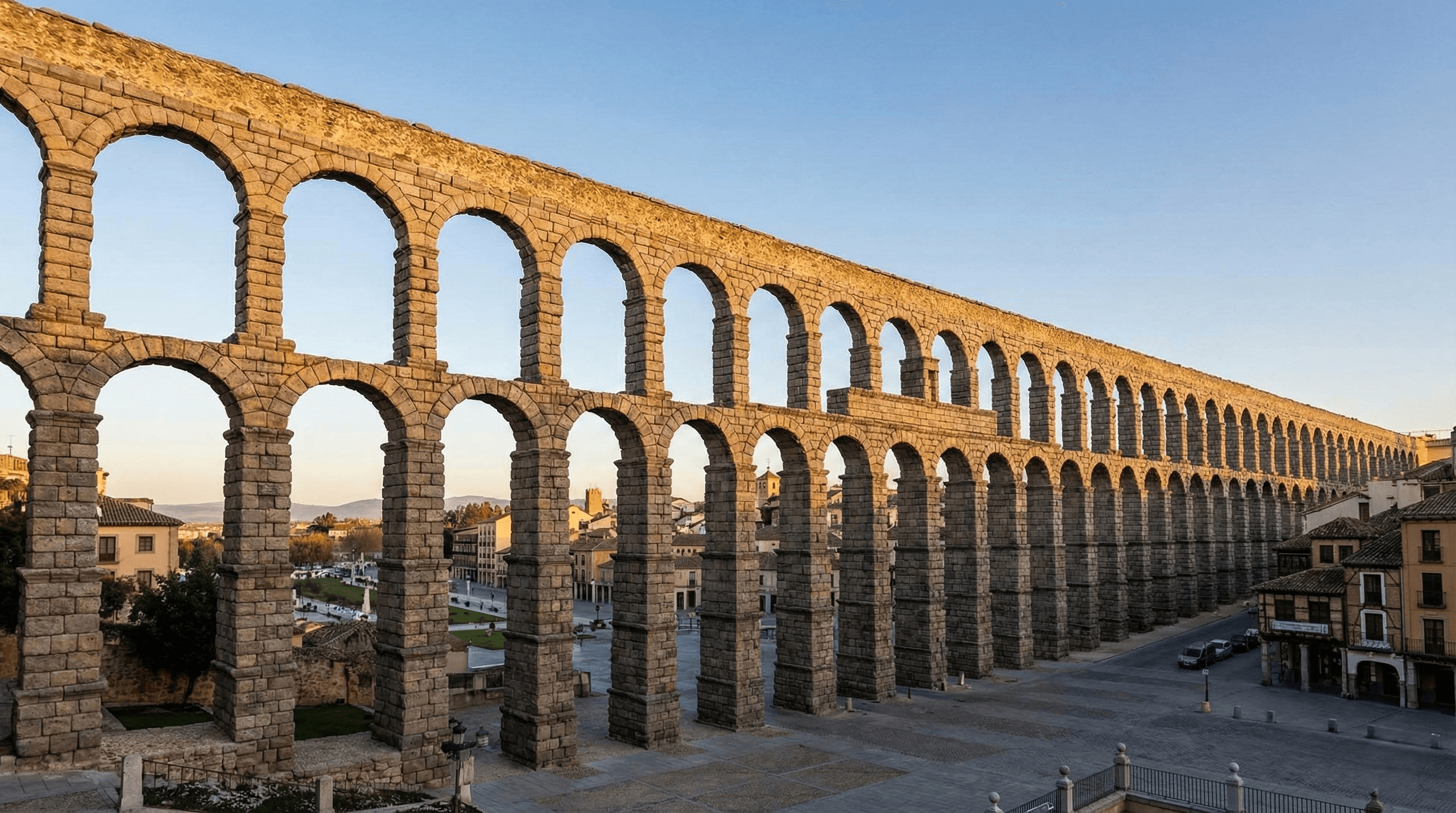
While most of the aqueduct network was actually built underground to protect the water from pollution and heat, the famous "bridge" sections were used to cross valleys. The primary structural element used was the arch. Instead of building a solid wall (which would use too much stone and block the wind), Romans used rows of arches called arcades.
- Compression: Arches are excellent at handling "compressive stress." The weight of the water and the stone is pushed downward and outward along the curve of the arch into the supporting pillars.
- Material Efficiency: Arches allowed the Romans to build very high structures while using much less stone than a solid wall (Fabretti, 2020).
1.4 Advanced Hydraulics: Inverted Siphons and Settling Tanks
Sometimes, an aqueduct had to cross a valley that was too deep for a stone bridge. In these cases, engineers used an inverted siphon. Water was fed into lead or clay pipes that went down one side of the valley and up the other. The pressure created by the water falling down one side pushed the water up the other side. This follows the Principle of Communicating Vessels, where liquid in connected containers stays at the same level (Hansen, 2015). Additionally, the Romans built settling tanks (piscinae) along the route. These were large basins where the water flow slowed down. This allowed sand, mud, and stones to sink to the bottom, ensuring that the water arriving in the city was clean and clear (Fabretti, 2020).
1.5 Materials Science: Roman Concrete and Lead
The longevity of these structures is due to Roman Concrete (opus caementicium). Unlike modern concrete, Romans mixed volcanic ash (pozzolana) with lime. This created a chemical reaction that allowed the concrete to set even under water and become stronger over centuries. The pipes inside the city were often made of lead (plumbum). While we now know lead is toxic, the Romans used it because it was easy to shape and did not leak easily. However, many pipes were also made of terracotta (clay) to avoid the high cost of lead (Aicher, 1995).
1.6 Conclusion
The Roman aqueducts represent a pinnacle of ancient STEM. They combined geography, mathematics, and material science to improve the quality of human life. For modern students, they serve as a reminder that the basic laws of physics such as gravity and fluid pressure have guided engineering for thousands of years.
1.7 Bibliography
Aicher, P.J. (1995). Guide to the Aqueducts of Ancient Rome. Wauconda: Bolchazy-Carducci Publishers.
Fabretti, G. (2020). The Hydraulic Works of Ancient Rome. [online] Engineering History Journal. Available at: https://www.worldhistory.org/Roman_Engineering/ [Accessed 20 Dec. 2025].
Hansen, R.D. (2015). Water and Wastewater Systems in Imperial Rome. [online] WaterHistory.org. Available at: http://www.waterhistory.org/histories/rome/ [Accessed 20 Dec. 2025].
Vitruvius, P. (approx. 15 BC). De Architectura (On Architecture). Translated by Bill Thayer. [online] Available at: https://penelope.uchicago.edu/Thayer/E/Roman/Texts/Vitruvius/8*.html [Accessed 20 Dec. 2025].
Test Your Knowledge!
Click the button below to generate an AI-powered quiz based on this article.
Did you enjoy this article?
Show your appreciation by giving it a like!
Conversation (0)
Cite This Article
Generating...

.png&w=3840&q=75)